

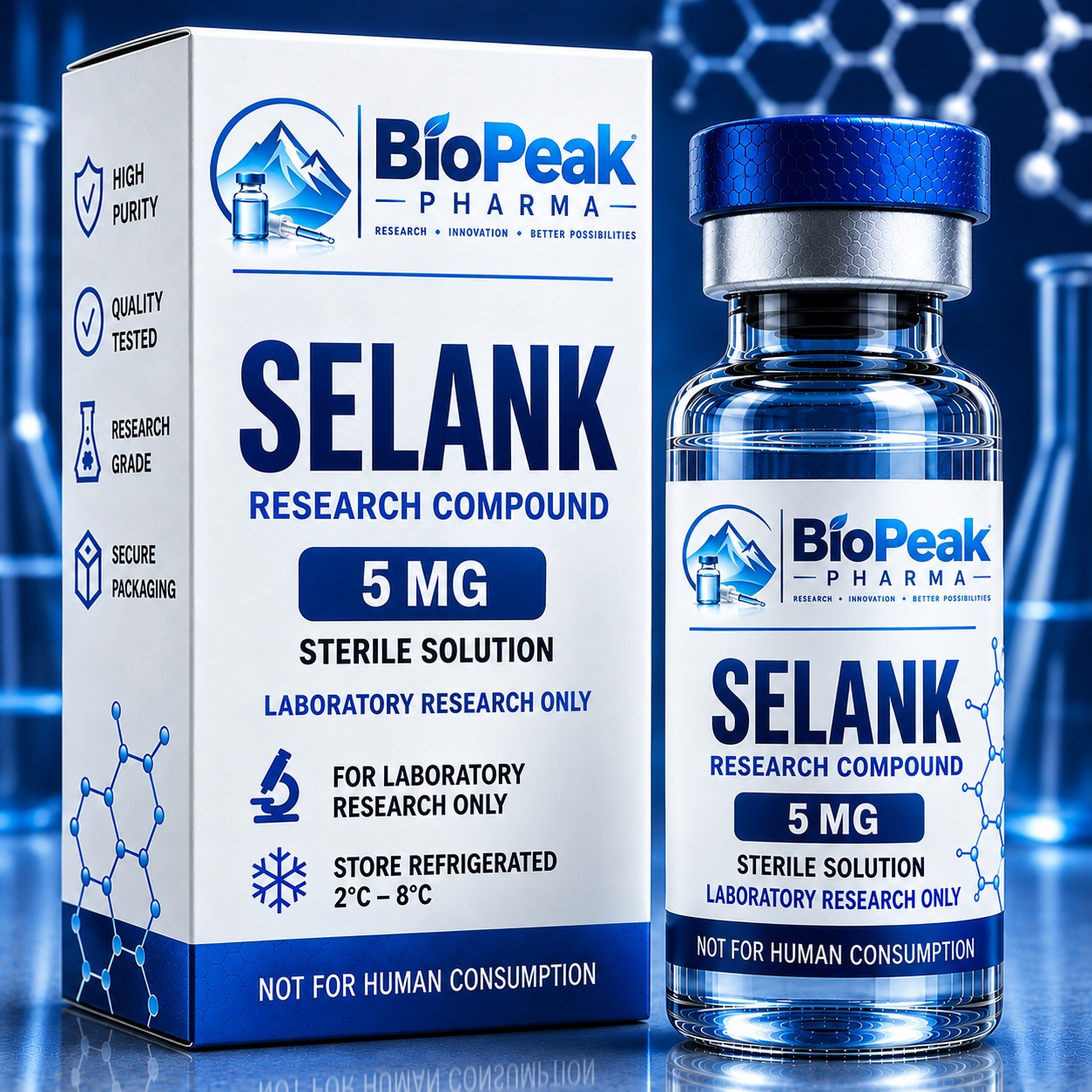
Buy Selank
$250.00
Selank
Selank is a synthetic peptide analogue derived from the naturally occurring immunomodulatory peptide tuftsin. It has been investigated in experimental research involving neurobiology, peptide pharmacology, immune signalling, stress-response pathways, and cellular communication.
Research into Selank has examined its potential interactions with biological pathways associated with neurotransmitter systems, neurotrophic signalling, inflammatory responses, and behavioural processes. Its compact peptide structure also makes it relevant to research exploring relationships between peptide sequence and biological activity.
Selank is an investigational research compound and should not be represented as an approved medicine, anti-anxiety treatment, nootropic, or product for human consumption or self-administration.
What Is Selank?
Selank is a synthetic analogue of tuftsin, a naturally occurring tetrapeptide associated with immune-system activity.
The commonly reported Selank sequence is:
Thr-Lys-Pro-Arg-Pro-Gly-Pro
This seven-amino-acid sequence is often written as TKPRPGP.
The peptide has been studied because of its relationship to both neurobiological and immunological signalling.
Selank Research
Laboratory research involving Selank may investigate:
- Neurobiology
- Peptide pharmacology
- Neurotransmitter signalling
- Immune-system pathways
- Stress-response mechanisms
- Neurotrophic signalling
- Inflammatory pathways
- Cellular communication
- Behavioural neuroscience
- Peptide structure-function relationships
These areas describe scientific investigation and should not be interpreted as established therapeutic uses.
Selank and Tuftsin
Selank is structurally related to tuftsin, a naturally occurring peptide involved in immunological research.
Tuftsin is a tetrapeptide, while Selank contains an additional peptide sequence that changes its molecular structure and research characteristics.
This distinction is important when interpreting scientific literature: research involving tuftsin should not automatically be considered evidence for identical biological effects from Selank.
Selank and Neurobiology
Selank has attracted research interest within experimental neuroscience.
Researchers have investigated the peptide in relation to neuronal signalling, neurotransmitter systems, neurotrophic mechanisms, and behavioural models.
Experimental work may examine how Selank interacts with signalling pathways involved in communication between neurons and other cells.
The biological response can depend on the experimental system, concentration, exposure conditions, and methodology.
Selank and Neurotransmitter Research
Neurotransmitters are chemical messengers involved in communication throughout the nervous system.
Selank research has explored relationships between the peptide and several neurotransmitter-related systems.
Laboratories may investigate:
- Neurotransmitter metabolism
- Receptor signalling
- Gene expression
- Synaptic communication
- Neuronal adaptation
- Stress-related signalling
These investigations can contribute to a broader understanding of peptide-mediated regulation within the nervous system.
Selank and Immune Research
Because Selank is derived from a tuftsin-related sequence, immune biology is an important part of its research background.
Researchers may investigate Selank in experimental systems involving:
- Immune-cell activity
- Cytokine signalling
- Inflammatory pathways
- Cellular communication
- Immune regulation
This makes Selank relevant to laboratories studying interactions between the nervous and immune systems.
Selank and Stress-Response Research
Stress responses involve complex interactions between the nervous, endocrine, and immune systems.
Selank has been investigated in experimental models exploring stress-related biological and behavioural responses.
Researchers may examine changes involving neurotransmitter pathways, gene expression, neurotrophic factors, and other molecular markers.
Such research remains exploratory and should not be described as proof that Selank treats anxiety or stress-related disorders.
Selank and Neurotrophic Signalling
Neurotrophic factors help regulate neuronal development, maintenance, differentiation, and adaptation.
Experimental research involving Selank has investigated pathways associated with neurotrophic signalling and neuronal function.
Researchers may use cellular and animal models to examine changes in neurotrophic factors and related molecular pathways.
Selank and Inflammatory Signalling
Inflammatory pathways play an important role in immune and neurological biology.
Selank research may examine interactions between the peptide and inflammatory signalling systems, including cytokine-related pathways.
This research is particularly relevant to studies exploring communication between immune cells and the nervous system.
Selank and Peptide Chemistry
Selank is also relevant to peptide chemistry and structure-function research.
Laboratories can investigate:
- Peptide identity
- Amino-acid sequence
- Purity
- Molecular weight
- Stability
- Solubility
- Degradation
- Structure-function relationships
Accurate analytical characterisation is important when evaluating experimental results involving synthetic peptides.
Selank Product Information
Product: Selank
Compound type: Synthetic peptide analogue
Related peptide: Tuftsin
Common sequence: TKPRPGP
Research areas: Neurobiology, immune signalling, peptide pharmacology, stress-response research and cellular signalling
Intended use: Laboratory research only
Human use: Not for human use
Veterinary use: Not for veterinary use
Researchers should consult current batch-specific documentation for exact information concerning sequence, molecular identity, purity, analytical testing, formulation, storage, and handling.
Quality and Analytical Documentation
Where available, researchers should review:
- Certificate of Analysis (CoA)
- Batch or lot number
- Peptide identity
- Sequence information
- Purity analysis
- Analytical testing
- Molecular-weight information
- Formulation details
- Storage requirements
- Handling documentation
Batch-specific records provide laboratories with traceability and help support reproducible experimental work.
Selank Storage and Handling
Selank should be handled by appropriately trained laboratory personnel using suitable laboratory procedures.
Storage requirements may vary depending on formulation, packaging, and supplier specifications. Researchers should follow current product documentation and institutional laboratory procedures.
Frequently Asked Questions
What is Selank?
Selank is a synthetic peptide analogue derived from the tuftsin peptide family and studied in neurobiology, immune signalling, peptide pharmacology, and cellular research.
What is the Selank sequence?
The commonly reported Selank sequence is TKPRPGP, representing Thr-Lys-Pro-Arg-Pro-Gly-Pro.
What is Selank derived from?
Selank is derived from tuftsin, a naturally occurring tetrapeptide associated with immune-system research.
Why is Selank researched?
Researchers investigate Selank in areas including neurobiology, neurotransmitter signalling, immune pathways, stress-response mechanisms, neurotrophic signalling, and peptide chemistry.
Is Selank the same as Semax?
No. Selank and Semax are different synthetic peptides with different structures and research backgrounds.
Is Selank a nootropic?
Selank is sometimes described as a nootropic in informal sources, but research-grade Selank should be described as an investigational peptide rather than an established cognitive-enhancement product.
Is Selank an anti-anxiety medication?
Selank should not be represented as an approved anti-anxiety medication. Research has explored its relationship with stress and neurological pathways, but experimental findings should not be presented as established clinical efficacy.
Is Selank FDA approved?
Selank should not be represented as an FDA-approved medication or established human treatment.
Is Selank intended for human use?
Research-grade Selank should be supplied for legitimate laboratory research and should not be marketed for human consumption or self-administration.
Research Disclaimer
This information is provided for educational and legitimate laboratory research purposes. It does not constitute medical advice, treatment guidance, or a recommendation for human use.
Selank research material is not intended for human consumption, self-administration, or veterinary use. Researchers are responsible for complying with applicable laws, regulations, institutional requirements, and laboratory safety procedures.
Selank Research Peptide
Selank is an interesting research peptide at the intersection of neurobiology, immunology, peptide chemistry, and cellular signalling.
Its relationship to tuftsin and its compact peptide sequence provide researchers with an experimental model for investigating interactions between peptide structure, immune pathways, neurotransmitter systems, and stress-related biological processes.
For laboratories researching Selank, accurate molecular identification, batch-specific analytical documentation, appropriate storage, careful handling, and responsible interpretation of experimental evidence are essential.
Be the first to review “Buy Selank”
Related products
Cognitive & Neuro Research
Reviews
There are no reviews yet.