
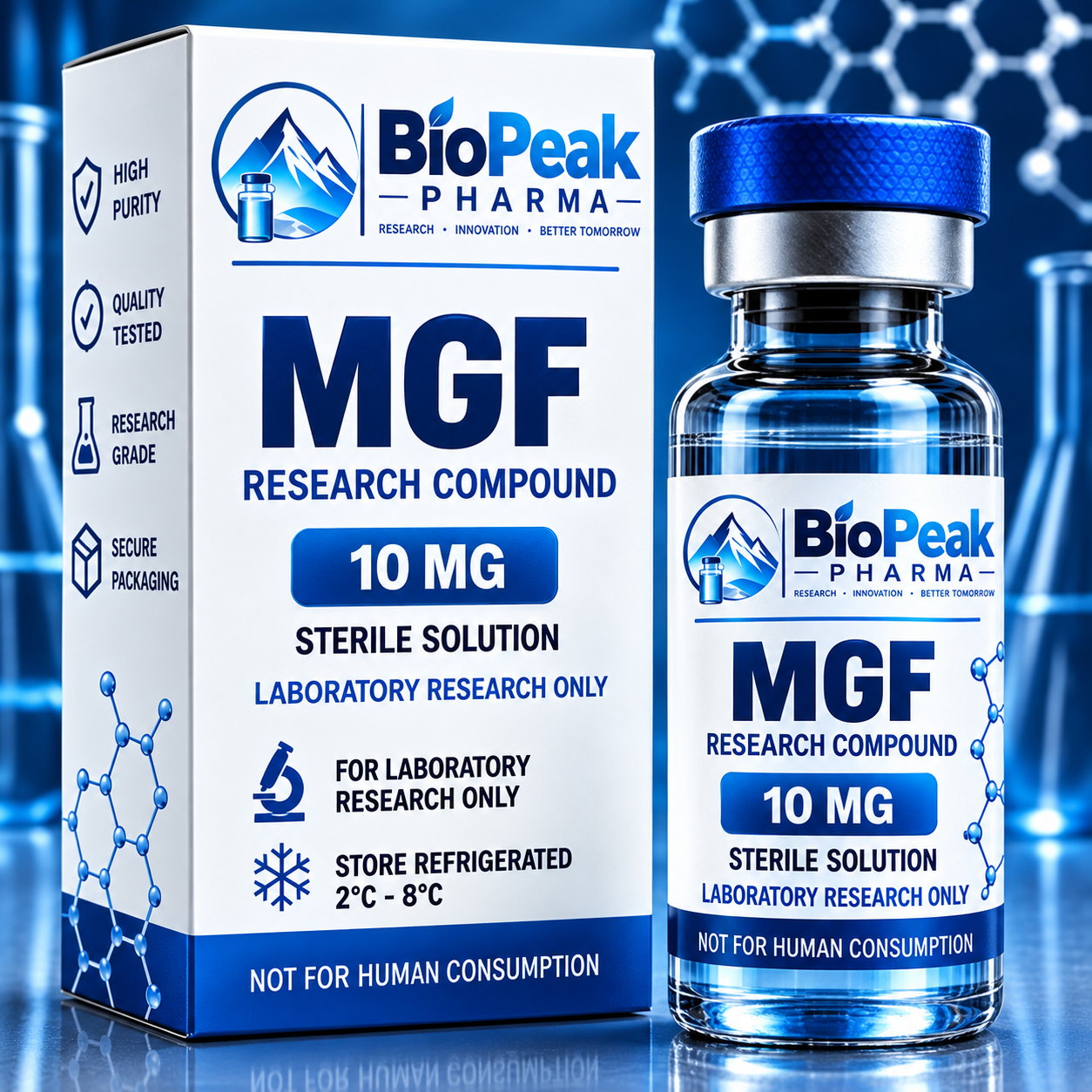
Buy PEG-MGF
$250.00
PEG-MGF
PEG-MGF (PEGylated Mechano Growth Factor) is a modified peptide associated with the insulin-like growth factor (IGF) family and studied in research involving muscle-cell biology, growth-factor signalling, cellular repair pathways, protein synthesis, and tissue biology.
PEG-MGF is derived from Mechano Growth Factor (MGF), a splice variant associated with insulin-like growth factor-1 (IGF-1). The addition of polyethylene glycol (PEG) is intended to modify the peptide’s physicochemical and pharmacokinetic characteristics, making PEG-MGF an interesting subject for peptide chemistry and growth-factor research.
The compound is particularly relevant to researchers investigating how mechanical or cellular stress can influence growth-factor signalling and downstream cellular responses.
PEG-MGF is an investigational research compound and should not be represented as an approved medicine, muscle-building treatment, or product for human consumption or self-administration.
What Is PEG-MGF?
PEG-MGF refers to a PEGylated form of Mechano Growth Factor, a peptide associated with IGF-1 biology.
MGF is commonly discussed in connection with alternative splicing of the IGF-1 gene. Research has investigated how different IGF-1-derived peptides may participate in cellular responses to mechanical stress and tissue changes.
PEGylation involves attaching a polyethylene glycol component to a peptide. This type of modification can alter characteristics such as molecular size, stability, solubility, and interactions with other molecules.
For researchers, PEG-MGF provides an experimental model for examining how peptide modification can influence the behaviour of an IGF-related molecule.
PEG-MGF and MGF
MGF, or Mechano Growth Factor, is a term used to describe an IGF-1 splice variant associated with tissue and cellular responses to mechanical stress.
PEG-MGF is a modified research form in which PEG is incorporated into the peptide.
The distinction is important because MGF and PEG-MGF are not identical compounds. Research performed using native IGF-1 or MGF should not automatically be interpreted as evidence for identical activity from PEG-MGF.
PEG-MGF Research
Laboratory research involving PEG-MGF may investigate:
- IGF-related signalling
- Growth-factor biology
- Muscle-cell research
- Cellular proliferation
- Cell differentiation
- Protein synthesis
- Tissue biology
- Peptide pharmacology
- Peptide stability
- PEGylation chemistry
- Structure-function relationships
- Cellular responses to mechanical stress
These represent scientific research areas rather than established therapeutic uses.
PEG-MGF and IGF-1 Research
PEG-MGF is closely associated with the broader IGF-1 signalling system.
IGF-1 is a naturally occurring growth factor involved in cellular growth, differentiation, metabolism, and tissue biology.
MGF is generally described as an IGF-1 splice variant associated with tissue responses to mechanical stress. Studying MGF-related peptides allows researchers to explore whether alternative IGF-derived sequences have distinct biological properties.
PEG-MGF extends this research area by allowing investigators to examine how PEG modification affects an IGF-related peptide.
PEG-MGF and Muscle-Cell Research
Muscle-cell biology is one of the areas in which MGF-related signalling has attracted scientific interest.
Researchers can study growth-factor pathways involved in:
- Muscle-cell differentiation
- Cellular proliferation
- Protein metabolism
- Cellular signalling
- Tissue adaptation
- Regenerative biology
PEG-MGF may therefore be used as an experimental compound in controlled research systems investigating growth-factor activity.
It should not, however, be described as an established muscle-building or athletic-performance treatment.
PEG-MGF and Protein Synthesis Research
Protein synthesis is a central component of cellular growth and tissue biology.
IGF-related signalling pathways have been studied in connection with protein metabolism and cellular responses.
Research involving PEG-MGF can help investigators examine how modified growth-factor peptides interact with cellular signalling systems associated with protein synthesis and tissue responses.
PEG-MGF and Cellular Signalling
Cellular signalling involves a network of receptors, enzymes, transcription factors, and intracellular pathways.
Growth factors such as IGF-1 can activate signalling cascades that influence cellular growth, metabolism, differentiation, and survival.
PEG-MGF provides researchers with a modified IGF-related peptide for investigating how structural changes can influence these biological interactions.
PEG-MGF and PEGylation Research
PEGylation is a widely studied peptide and protein modification technique involving the attachment of polyethylene glycol chains.
Researchers use PEGylation to investigate how chemical modification affects properties such as:
- Molecular size
- Solubility
- Stability
- Protein interactions
- Peptide behaviour
- Pharmacokinetics
PEG-MGF is therefore relevant not only to growth-factor research but also to the broader field of peptide modification and pharmaceutical chemistry.
PEG-MGF and Peptide Stability
One reason PEGylated peptides are scientifically interesting is that adding a PEG component can alter how a peptide behaves in experimental systems.
Researchers may investigate the relationship between PEG modification and:
- Peptide stability
- Molecular interactions
- Degradation
- Solubility
- Cellular exposure
- Pharmacological characteristics
The exact properties depend on the molecular structure and PEG modification used.
PEG-MGF Product Information
Product: PEG-MGF
Full name: PEGylated Mechano Growth Factor
Related molecule: Mechano Growth Factor / IGF-1-related peptide
Compound type: PEG-modified peptide
Research areas: Growth-factor signalling, muscle-cell biology, peptide chemistry and cellular research
Intended use: Laboratory research only
Human use: Not for human use
Veterinary use: Not for veterinary use
Researchers should consult current batch-specific documentation for exact information concerning molecular identity, sequence, PEG modification, purity, analytical testing, molecular characteristics, storage, and handling.
Quality and Analytical Documentation
Because PEGylation can create additional structural complexity, accurate analytical characterisation is especially important.
Where available, researchers should review:
- Certificate of Analysis (CoA)
- Batch or lot number
- Peptide identity
- Sequence information
- PEG modification information
- Purity analysis
- Analytical testing
- Molecular-weight information
- Storage requirements
- Handling documentation
Batch-specific documentation provides laboratories with a clearer record of the material used during experimental work.
PEG-MGF Storage and Handling
PEG-MGF should be handled by appropriately trained laboratory personnel using suitable laboratory procedures.
Storage requirements may vary according to formulation, packaging, and manufacturer specifications. Researchers should follow the current product documentation for appropriate storage and handling rather than relying on generic online recommendations.
Frequently Asked Questions
What is PEG-MGF?
PEG-MGF is a PEGylated form of Mechano Growth Factor, an IGF-1-related peptide investigated in growth-factor, cellular, muscle-cell, and peptide chemistry research.
What does PEG-MGF stand for?
PEG-MGF stands for PEGylated Mechano Growth Factor.
What is MGF?
MGF, or Mechano Growth Factor, is a term commonly used for an IGF-1 splice variant associated with cellular responses to mechanical stress.
Is PEG-MGF the same as MGF?
No. PEG-MGF is a modified form of MGF incorporating a polyethylene glycol component.
Is PEG-MGF the same as IGF-1?
No. PEG-MGF and IGF-1 are distinct research compounds. MGF is associated with an alternatively spliced form of IGF-1, while PEG-MGF represents a modified form of MGF.
Why is PEG-MGF researched?
Researchers investigate PEG-MGF in areas including growth-factor signalling, muscle-cell biology, cellular responses, protein synthesis, peptide stability, and PEGylation chemistry.
What is PEGylation?
PEGylation is the process of attaching a polyethylene glycol component to a peptide or protein. Researchers study the technique because it can alter physicochemical and pharmacokinetic characteristics.
Is PEG-MGF a growth hormone?
No. PEG-MGF is a modified IGF-related peptide and is distinct from human growth hormone (GH).
Is PEG-MGF FDA approved?
PEG-MGF should not be represented as an FDA-approved medication or established human treatment.
Is PEG-MGF intended for human use?
Research-grade PEG-MGF should be supplied for legitimate laboratory research and should not be marketed for human consumption or self-administration.
Research Disclaimer
This information is provided for educational and legitimate laboratory research purposes. It does not constitute medical advice, treatment guidance, or a recommendation for human use.
PEG-MGF research material is not intended for human consumption, self-administration, or veterinary use. Researchers are responsible for complying with applicable laws, regulations, institutional requirements, and laboratory safety procedures.
PEG-MGF Research Peptide
PEG-MGF represents an interesting intersection between growth-factor biology and peptide modification research.
By combining an IGF-related peptide with PEGylation, researchers can investigate how structural modifications influence peptide characteristics and biological behaviour.
Its connection to MGF and the broader IGF-1 signalling system makes PEG-MGF relevant to research involving cellular signalling, muscle-cell biology, protein metabolism, peptide chemistry, and tissue biology.
For laboratories researching PEG-MGF, accurate molecular identification, batch-specific analytical documentation, appropriate handling, and careful interpretation of experimental findings are essential.
Be the first to review “Buy PEG-MGF”
Related products
Muscle & Performance Research
Muscle & Performance Research
Muscle & Performance Research
Reviews
There are no reviews yet.