
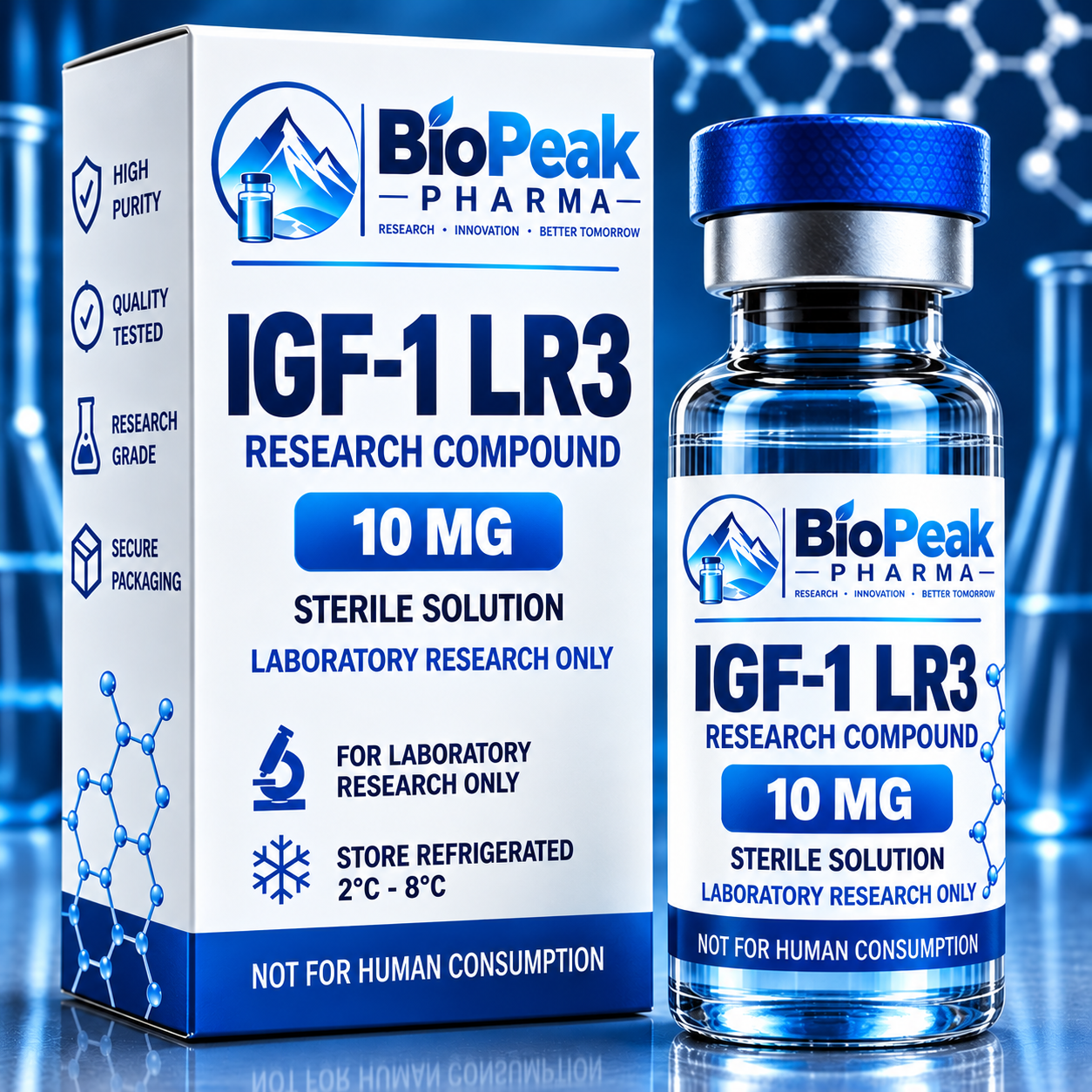
IGF-1 LR3
$250.00
IGF-1 LR3
IGF-1 LR3 (Insulin-like Growth Factor-1 Long R3) is a modified form of insulin-like growth factor-1 (IGF-1) that is widely studied in molecular biology, cellular signalling, metabolism, and growth-factor research.
IGF-1 is a naturally occurring peptide involved in biological pathways associated with cellular growth, differentiation, metabolism, and tissue development. IGF-1 LR3 is a structurally modified analogue developed as a research tool for investigating IGF-related activity and receptor signalling under controlled laboratory conditions.
Because of its distinctive structure and biological properties, IGF-1 LR3 peptide research has attracted interest across cellular biology, muscle-cell research, metabolic studies, receptor pharmacology, and peptide structure-function research.
IGF-1 LR3 is an investigational research compound. It should not be represented as an approved medicine, performance-enhancing treatment, or product for human consumption or self-administration.
What Is IGF-1 LR3?
IGF-1 LR3 is a synthetic analogue of human IGF-1.
The LR3 designation refers to modifications made to the natural IGF-1 structure. These modifications include an amino-acid substitution in the N-terminal region and an extension of the peptide sequence.
These structural differences are important because changes to a peptide’s structure can influence its interaction with receptors, binding proteins, stability, and biological behaviour.
For researchers, IGF-1 LR3 provides an experimental model for studying how modifications to the IGF-1 molecule affect growth-factor signalling.
IGF-1 LR3 vs IGF-1
Although IGF-1 LR3 is derived from IGF-1, the two molecules are not identical.
IGF-1 is a naturally occurring growth factor involved in numerous cellular and metabolic processes.
IGF-1 LR3 is a modified synthetic analogue designed for experimental research.
This distinction matters when interpreting scientific literature. Results obtained using native IGF-1 should not automatically be presented as evidence for identical effects from IGF-1 LR3.
IGF-1 LR3 Research Areas
Researchers may investigate IGF-1 LR3 in areas including:
- Growth-factor signalling
- IGF-1 receptor biology
- Cellular proliferation
- Cell differentiation
- Protein synthesis
- Muscle-cell biology
- Metabolic signalling
- Molecular biology
- Peptide pharmacology
- Receptor interactions
- Tissue biology
- Cellular survival pathways
These are research areas rather than established therapeutic indications.
IGF-1 LR3 and IGF-1 Receptor Research
A major focus of IGF-1 LR3 research is the IGF-1 receptor (IGF1R).
IGF1R is a receptor tyrosine kinase that participates in signalling pathways involved in cellular growth, metabolism, differentiation, and survival.
When researchers study IGF-related compounds, they can examine receptor activation and downstream signalling events to better understand how growth-factor pathways operate.
IGF-1 LR3 can therefore be useful in controlled experimental systems examining the relationship between peptide structure and receptor-mediated signalling.
IGF-1 LR3 and Cellular Growth Research
Cellular growth and differentiation are fundamental areas of biological research.
IGF-related signalling can influence intracellular pathways involved in cell growth, protein metabolism, and differentiation.
Researchers investigating IGF-1 LR3 may examine cellular responses such as:
- Changes in cell proliferation
- Differentiation
- Protein synthesis
- Receptor signalling
- Intracellular pathway activation
- Cellular metabolic responses
The specific response can vary according to cell type, experimental conditions, concentration, and assay design.
IGF-1 LR3 and Muscle Research
IGF signalling is an important research topic in skeletal-muscle biology.
Laboratory studies can examine how IGF-related signalling interacts with muscle cells, protein metabolism, cellular differentiation, and tissue development.
IGF-1 LR3 is consequently discussed within experimental muscle research and growth-factor biology.
However, it should not be described as an established muscle-building or athletic-performance treatment.
IGF-1 LR3 and Metabolic Research
IGF-1 signalling has connections with broader metabolic pathways.
Researchers may use IGF-related experimental compounds to investigate interactions between growth-factor signalling, glucose metabolism, amino-acid metabolism, protein synthesis, and cellular energy regulation.
This makes IGF-1 LR3 relevant to laboratory studies examining the relationship between growth and metabolism.
IGF-1 LR3 and Protein Synthesis Research
Protein synthesis is a major downstream process investigated in growth-factor biology.
IGF signalling can influence intracellular pathways associated with protein metabolism and cellular growth.
Researchers may therefore use IGF-1 LR3 as an experimental compound when investigating how modified IGF molecules affect signalling pathways associated with protein synthesis.
IGF-1 LR3 and Peptide Structure Research
One of the scientifically interesting aspects of IGF-1 LR3 is its modified molecular structure.
Comparing IGF-1 with modified analogues allows researchers to examine how specific structural changes can influence:
- Receptor binding
- Molecular stability
- Peptide interactions
- Biological activity
- Signalling behaviour
- Structure-function relationships
This makes IGF-1 LR3 relevant to peptide chemistry and molecular pharmacology research.
IGF-1 LR3 and Growth-Factor Biology
Growth factors are signalling molecules that regulate numerous cellular processes.
IGF-1 belongs to a broader network of growth-factor pathways that interact with receptors, binding proteins, intracellular kinases, and metabolic systems.
Research involving IGF-1 LR3 can therefore contribute to a better understanding of how growth-factor signals are generated, transmitted, and regulated at the cellular level.
IGF-1 LR3 Product Information
Product: IGF-1 LR3
Full name: Insulin-like Growth Factor-1 Long R3
Related molecule: IGF-1
Compound type: Synthetic peptide analogue
Research focus: Growth-factor and cellular signalling
Research areas: Molecular biology, metabolism, receptor biology, muscle-cell research and peptide pharmacology
Intended use: Laboratory research only
Human use: Not for human use
Veterinary use: Not for veterinary use
Researchers should refer to current batch-specific documentation for exact information regarding identity, purity, analytical testing, molecular characteristics, storage requirements, and handling.
Quality and Analytical Documentation
Accurate characterisation is particularly important when working with modified peptide analogues.
Where available, researchers should review:
- Certificate of Analysis (CoA)
- Batch or lot number
- Peptide identity
- Sequence information
- Purity analysis
- Analytical testing
- Molecular-weight information
- Storage requirements
- Handling documentation
Reliable batch documentation helps laboratories maintain consistent experimental records and compare results across studies.
Storage and Handling
IGF-1 LR3 should be handled by appropriately trained laboratory personnel using suitable laboratory procedures.
Storage requirements can vary according to formulation, packaging, and manufacturer specifications. Researchers should therefore follow the current product documentation rather than relying on generic online storage recommendations.
Frequently Asked Questions
What is IGF-1 LR3?
IGF-1 LR3 is a modified synthetic analogue of insulin-like growth factor-1 studied in growth-factor signalling, cellular biology, metabolism, and molecular research.
What does IGF-1 LR3 stand for?
IGF-1 LR3 stands for Insulin-like Growth Factor-1 Long R3.
Is IGF-1 LR3 a peptide?
Yes. IGF-1 LR3 is a modified peptide analogue of IGF-1.
Is IGF-1 LR3 the same as IGF-1?
No. IGF-1 LR3 is structurally modified compared with naturally occurring IGF-1.
What is IGF-1 LR3 used for in research?
Researchers investigate IGF-1 LR3 in areas such as receptor signalling, cellular growth, differentiation, metabolism, protein synthesis, muscle-cell biology, and peptide structure-function relationships.
Is IGF-1 LR3 a growth hormone?
No. IGF-1 LR3 is an IGF-1 analogue and is chemically and biologically distinct from human growth hormone (GH).
Is IGF-1 LR3 a peptide hormone?
IGF-1 is a naturally occurring peptide hormone/growth factor, while IGF-1 LR3 is a synthetic analogue used as an experimental research compound.
Is IGF-1 LR3 FDA approved?
IGF-1 LR3 should not be represented as an FDA-approved medication or established human treatment.
Is IGF-1 LR3 intended for human use?
Research-grade IGF-1 LR3 should be supplied for legitimate laboratory research and should not be marketed for human consumption or self-administration.
What is the difference between IGF-1 LR3 and IGF-1 DES?
IGF-1 LR3 and IGF-1 DES are different modified IGF-1 analogues with different structural modifications. They should be treated as separate research compounds.
Research Disclaimer
This information is provided for educational and legitimate laboratory research purposes. It does not constitute medical advice, treatment guidance, or a recommendation for human use.
IGF-1 LR3 research material is not intended for human consumption, self-administration, or veterinary use. Researchers are responsible for complying with applicable laws, regulations, institutional requirements, and laboratory safety procedures.
IGF-1 LR3 Research Peptide
IGF-1 LR3 is an important experimental compound for studying growth-factor signalling, receptor biology, cellular growth, metabolism, protein synthesis, and peptide structure-function relationships.
Its modified structure makes it particularly relevant to researchers interested in how changes to IGF-1 can influence molecular interactions and cellular signalling.
For laboratories researching IGF-1 LR3, accurate compound identification, batch-specific analytical documentation, appropriate handling, and careful interpretation of experimental results are essential.
Be the first to review “IGF-1 LR3”
Related products
Muscle & Performance Research
Muscle & Performance Research
Muscle & Performance Research
Reviews
There are no reviews yet.