
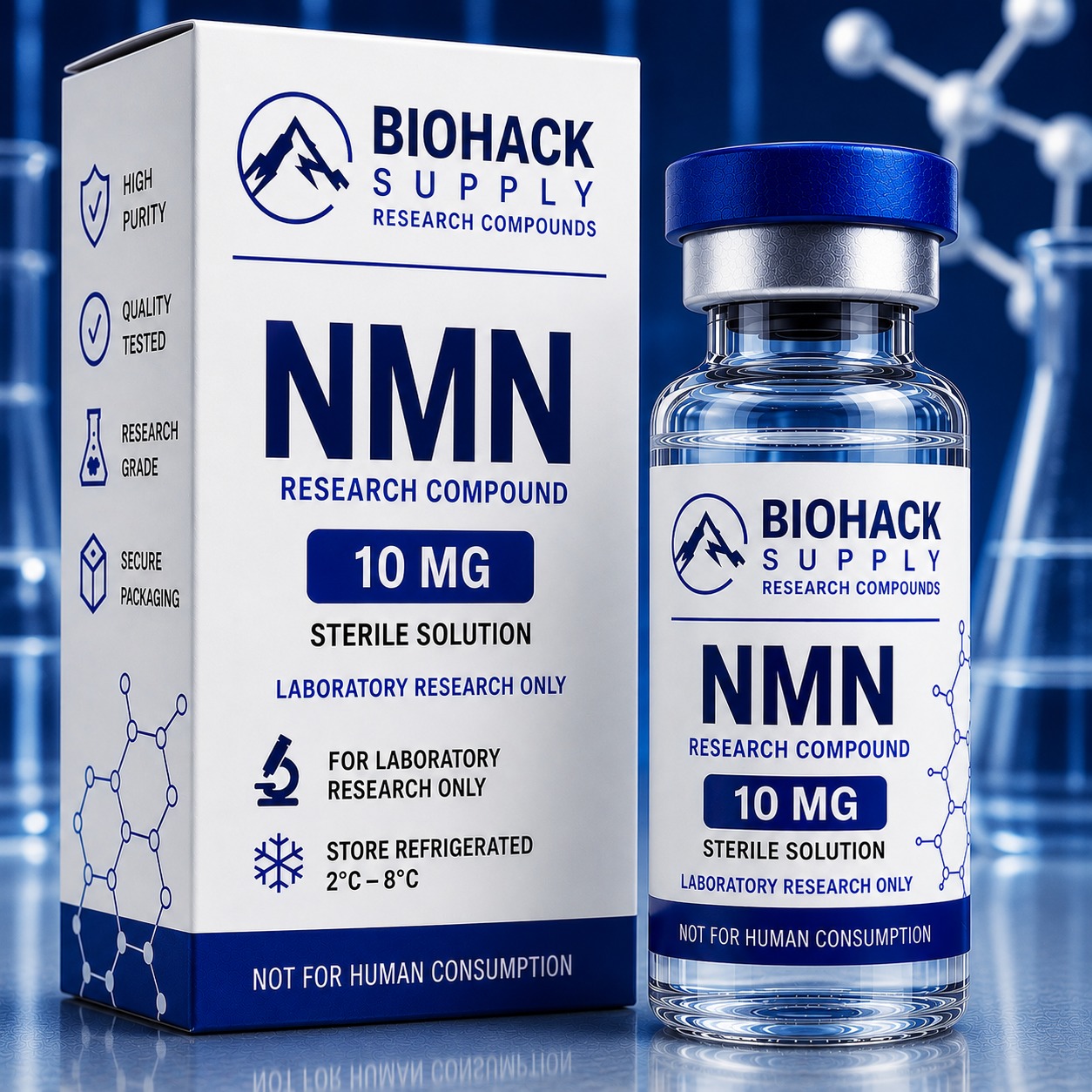
Buy NMN 10mg
$250.00
NMN
NMN (nicotinamide mononucleotide) is a naturally occurring nucleotide and an important intermediate in the biosynthesis of NAD+ (nicotinamide adenine dinucleotide). It has become a significant subject of research involving cellular metabolism, mitochondrial biology, ageing-related pathways, energy metabolism, and NAD+ biology.
NMN is found in several biological systems and exists as an intermediate within pathways responsible for maintaining cellular NAD+ pools. Because NAD+ participates in energy metabolism and numerous cellular signalling processes, researchers have developed considerable interest in understanding how NMN contributes to NAD+ metabolism.
NMN research material is supplied for laboratory research purposes only and is not intended for human consumption, self-administration, or veterinary use.
What Is NMN?
NMN stands for nicotinamide mononucleotide. It is a nucleotide composed of a nicotinamide group, a ribose sugar, and a phosphate group.
NMN is closely associated with NAD+ biosynthesis. Within cells, NMN can participate in the pathway that produces NAD+, making it an important research molecule for laboratories investigating cellular cofactor metabolism.
Research into NMN commonly focuses on how NAD+ levels are regulated and how changes in NAD+ metabolism may influence cellular processes.
NMN and NAD+ Research
The relationship between NMN and NAD+ is central to much of the scientific interest surrounding NMN.
NAD+ is required for numerous biochemical reactions, including redox reactions involved in cellular metabolism. It also serves as a substrate for enzyme families involved in cellular signalling and DNA damage responses.
NMN is an intermediate in the biosynthetic pathway that contributes to cellular NAD+ production. Researchers can therefore study NMN to better understand NAD+ metabolism, cellular energy pathways, and related biological mechanisms.
NMN Research Applications
Laboratory research involving NMN may investigate:
- NAD+ biosynthesis
- Cellular metabolism
- Mitochondrial biology
- Energy metabolism
- Redox biology
- Cellular signalling
- Ageing-related pathways
- Sirtuin biology
- DNA repair research
- Metabolic regulation
- Nucleotide metabolism
These represent areas of scientific research and should not be interpreted as established therapeutic effects.
NMN and Cellular Energy
NAD+ plays a fundamental role in cellular energy metabolism, and NMN is closely connected to the production and maintenance of cellular NAD+.
Researchers studying NMN can investigate how changes in NAD+ biosynthesis influence metabolic pathways and mitochondrial processes.
This makes NMN particularly relevant to research into cellular energy production and metabolic regulation.
NMN and Mitochondrial Research
Mitochondria rely on interconnected metabolic pathways to generate cellular energy. NAD+ is an important component of these pathways, and NMN is closely linked to NAD+ biosynthesis.
Researchers may investigate NMN within experimental models involving mitochondrial metabolism, redox balance, energy production, and cellular stress responses.
NMN and Ageing Research
NMN has attracted significant attention in ageing biology because of its connection to NAD+ metabolism.
Research into ageing examines numerous processes, including mitochondrial function, cellular stress, DNA repair, metabolic regulation, and changes in cellular signalling.
Because NAD+ metabolism is involved in several of these pathways, researchers have investigated NMN as a tool for studying how NAD+ availability and biosynthesis relate to age-associated cellular changes.
However, laboratory research should not be interpreted as proof that NMN reverses ageing, extends human lifespan, or provides an established anti-ageing treatment.
NMN and Sirtuin Research
NAD+ serves as a substrate for sirtuins, a family of NAD+-dependent enzymes involved in cellular regulation.
Because NMN participates in NAD+ biosynthesis, researchers may study NMN within experimental systems examining relationships between NAD+ metabolism and sirtuin activity.
This provides an additional research connection between NMN, cellular signalling, metabolism, and ageing-related biology.
NMN and NAD+ Biosynthesis
NMN occupies an important position within the NAD+ biosynthetic pathway.
A simplified representation of one pathway is:
Nicotinamide → NMN → NAD+
This relationship makes NMN useful for researchers studying how cells produce and maintain NAD+.
NAD+ metabolism is complex, however, and cells can use multiple pathways and precursors to maintain their NAD+ pools.
NMN Product Information
Product: NMN
Full name: Nicotinamide mononucleotide
Related cofactor: NAD+
Compound type: Nucleotide
Research areas: NAD+ metabolism, cellular energy, mitochondrial biology and ageing research
Intended use: Laboratory research only
Human use: Not for human use
Veterinary use: Not for veterinary use
Researchers should consult current product documentation for compound identity, purity information, analytical testing, batch details, storage requirements, and handling instructions.
Quality and Documentation
Reliable laboratory research depends on accurate product identification and appropriate documentation.
Where available, researchers should review:
- Certificate of Analysis (CoA)
- Batch or lot information
- Compound identification
- Purity information
- Analytical testing
- Molecular information
- Storage guidance
- Handling documentation
Maintaining accurate research records can help laboratories compare results across experiments and batches.
Storage and Handling
NMN should be handled by appropriately trained laboratory personnel using suitable laboratory procedures.
Storage requirements may vary according to the specific product formulation and packaging. Researchers should therefore follow the current product-specific documentation and applicable laboratory requirements.
Frequently Asked Questions
What is NMN?
NMN stands for nicotinamide mononucleotide. It is a nucleotide and an intermediate in the biosynthesis of NAD+, making it an important subject of research into cellular metabolism and NAD+ biology.
What does NMN stand for?
NMN stands for nicotinamide mononucleotide.
What is the relationship between NMN and NAD+?
NMN is an intermediate in cellular NAD+ biosynthesis. Researchers study this relationship to understand how cells produce and maintain NAD+.
Is NMN a peptide?
No. NMN is not a peptide. It is a nucleotide involved in NAD+ metabolism.
Why is NMN studied in ageing research?
NMN is studied because of its connection to NAD+ metabolism, while NAD+ participates in cellular processes involving energy metabolism, mitochondrial function, DNA repair, and cellular signalling.
Is NMN the same as NAD+?
No. NMN and NAD+ are different molecules. NMN is an intermediate involved in the biosynthesis of NAD+.
Is NMN intended for human use as a research product?
Research-grade NMN should be supplied for legitimate laboratory research and should not be marketed for human consumption or self-administration.
Research Disclaimer
This information is provided for educational and legitimate laboratory research purposes. It does not constitute medical advice, treatment guidance, or a recommendation for human use.
NMN research material is not intended for human consumption, self-administration, or veterinary use. Researchers are responsible for complying with applicable laws, regulations, institutional requirements, and laboratory safety procedures.
NMN Research Compound
NMN is an important research molecule within the broader field of NAD+ biology. Its position within NAD+ biosynthesis makes it relevant to studies involving cellular metabolism, mitochondrial function, redox biology, ageing-related mechanisms, and cellular signalling.
For laboratories investigating NMN and NAD+ metabolism, accurate product identification, appropriate analytical documentation, controlled handling, and responsible research practices provide an important foundation for reproducible experimental work.
Be the first to review “Buy NMN 10mg”
Related products
Anti-Aging & Longevity
Anti-Aging & Longevity
Anti-Aging & Longevity
Anti-Aging & Longevity

Anti-Aging & Longevity
Anti-Aging & Longevity
Reviews
There are no reviews yet.