
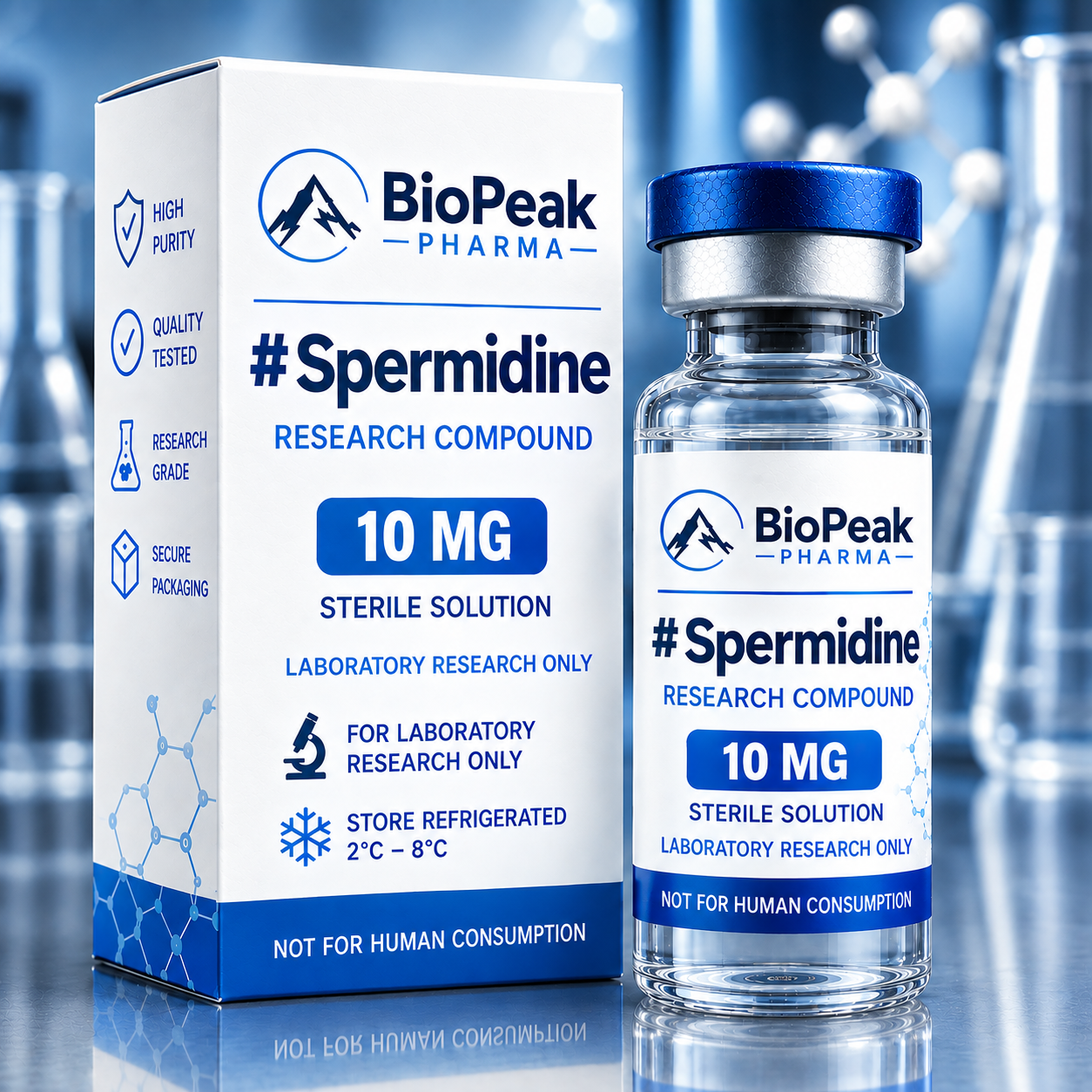
Buy Spermidine 10mg
$110.00
Spermidine
Spermidine is a naturally occurring polyamine found throughout living organisms and an important subject of research in cellular biology, autophagy, ageing research, metabolism, mitochondrial function, and molecular science.
Spermidine has attracted particular scientific interest because of its relationship with autophagy, the cellular process responsible for breaking down and recycling damaged or unnecessary cellular components. Research has also investigated spermidine in connection with cellular homeostasis, mitochondrial function, oxidative balance, protein quality control, and ageing-related biological pathways.
Unlike peptides such as GHK-Cu or Epitalon, spermidine is not a peptide. It is a small naturally occurring polyamine that participates in numerous biological processes.
Our Spermidine research material is intended for legitimate laboratory research only and should not be marketed for human consumption, self-administration, or veterinary use.
What Is Spermidine?
Spermidine is a naturally occurring polyamine that is present in cells and tissues across many organisms. It is biosynthetically related to other polyamines, including putrescine and spermine.
Polyamines are involved in a wide range of cellular processes, including regulation of gene expression, protein synthesis, cell growth, cellular stress responses, and molecular stability.
Spermidine is particularly interesting to researchers because it has been associated with regulation of autophagy and other mechanisms involved in maintaining cellular homeostasis.
Spermidine and Autophagy
One of the most extensively studied areas of spermidine research is autophagy.
Autophagy is a natural cellular recycling process through which cells identify, break down, and recycle damaged proteins and cellular components. This process contributes to cellular quality control and homeostasis.
Research has identified spermidine as an autophagy-modulating polyamine and has investigated the molecular mechanisms through which spermidine may influence autophagic activity.
This connection between spermidine and autophagy is one of the major reasons the compound has become prominent in ageing and cellular-maintenance research.
Spermidine and Longevity Research
Spermidine is widely studied within the field of longevity and ageing biology.
Preclinical research has reported associations between spermidine and lifespan or healthspan-related outcomes in several model organisms. Researchers have proposed that mechanisms involving autophagy, cellular maintenance, mitochondrial function, and metabolic regulation may contribute to these observations.
However, laboratory findings in model organisms should not automatically be interpreted as proof of a lifespan-extending effect in humans.
Current reviews continue to describe spermidine as a promising research molecule while noting that larger and better-controlled human studies are needed to establish its clinical significance.
Spermidine and Cellular Ageing
Ageing involves complex changes across multiple cellular systems.
Researchers studying cellular ageing investigate mechanisms such as:
- Autophagy
- Mitochondrial function
- Oxidative balance
- Protein quality control
- Cellular signalling
- DNA and epigenetic regulation
- Inflammation
- Metabolic changes
Spermidine is relevant to this field because research has connected its biology with several of these processes.
Rather than focusing on one isolated pathway, researchers can use spermidine as a model for investigating how polyamine metabolism interacts with cellular maintenance and ageing-associated mechanisms.
Spermidine and Mitochondrial Research
Mitochondria are essential components of cellular energy metabolism and play an important role in maintaining cellular homeostasis.
Research has investigated relationships between spermidine, autophagy, mitochondrial quality control, and cellular energy regulation. Recent reviews also describe spermidine as a compound of interest in research involving mitochondrial function and oxidative balance.
This makes spermidine relevant to experimental research involving mitochondrial biology, metabolic signalling, and cellular stress responses.
Spermidine and Cellular Recycling
A major concept in spermidine research is cellular recycling.
Through autophagy and related quality-control mechanisms, cells can remove or recycle damaged components. Researchers study these processes because maintaining cellular quality control is fundamental to healthy cell function.
Spermidine provides an experimental model for investigating the molecular regulation of these pathways and their relationship to cellular stress and ageing.
Spermidine and Brain Ageing Research
Spermidine has also become an area of interest in research involving the ageing brain.
Recent reviews describe potential relationships between spermidine biology, autophagy, mitochondrial function, oxidative balance, neuroinflammatory signalling, and cognitive ageing. However, the authors emphasise that human evidence remains limited and that further well-designed clinical research is needed.
This makes spermidine an interesting compound for neuroscience and cellular-ageing research without requiring unsupported claims about treating neurological disease.
Spermidine Research Applications
Laboratory research involving spermidine may investigate:
- Autophagy
- Cellular ageing
- Longevity biology
- Polyamine metabolism
- Mitochondrial function
- Cellular homeostasis
- Protein quality control
- Oxidative stress
- Cellular signalling
- Metabolic regulation
- Neurobiology
- Ageing-related pathways
- Molecular biology
These are areas of scientific investigation rather than established therapeutic indications.
Spermidine and Polyamine Biology
Spermidine belongs to the polyamine family, which also includes putrescine and spermine.
Polyamines are involved in fundamental biological processes and can interact with nucleic acids, proteins, membranes, and other cellular components.
Researchers studying polyamine metabolism may investigate how cells synthesise, transport, utilise, and regulate these molecules.
Spermidine therefore provides an important research model for understanding the broader biology of polyamines.
Spermidine and eIF5A Research
One interesting molecular pathway connecting spermidine with cellular biology involves eIF5A hypusination.
Spermidine provides the aminobutyl group required for the hypusination of eIF5A, an important post-translational modification involved in cellular protein synthesis and function.
Research into spermidine metabolism therefore extends beyond autophagy and includes molecular processes involving protein translation and cellular regulation.
This adds another layer to the biological significance of spermidine and makes it relevant to molecular and biochemical research.
Spermidine Research and Autophagic Signalling
Researchers have investigated multiple molecular pathways associated with spermidine-mediated autophagy.
These studies have examined mechanisms involving cellular signalling, acetylation, metabolic regulation, and autophagic machinery. Current research continues to investigate how spermidine interacts with these pathways and whether its biological effects differ across tissues and experimental models.
Because autophagy is highly complex, spermidine should not be described as simply an “autophagy activator” without explaining the broader biological context.
Spermidine Product Information
Product: Spermidine
Compound class: Naturally occurring polyamine
Research focus: Autophagy, polyamine metabolism, cellular ageing and mitochondrial biology
Related polyamines: Putrescine and spermine
Research areas: Cellular biology, longevity research, molecular biology and metabolic research
Intended use: Laboratory research only
Human use: Not for human use
Veterinary use: Not for veterinary use
Researchers should consult the current product documentation for specific information concerning identity, purity, analytical testing, batch details, storage requirements, and handling procedures.
Quality and Documentation
Reliable research begins with accurate compound identification and appropriate analytical documentation.
Where available, researchers should review:
- Certificate of Analysis (CoA)
- Batch or lot information
- Compound identification
- Purity information
- Analytical testing
- Molecular information
- Storage guidance
- Handling documentation
Maintaining accurate batch records can help laboratories improve consistency when comparing experimental results.
Storage and Handling
Spermidine should be handled by appropriately trained laboratory personnel using appropriate laboratory procedures.
Storage requirements depend on the specific formulation and packaging. Researchers should follow the current product-specific documentation rather than relying on generic online storage recommendations.
Frequently Asked Questions
What is spermidine?
Spermidine is a naturally occurring polyamine involved in numerous cellular processes. It is particularly well studied in relation to autophagy, cellular homeostasis, metabolism, and ageing biology.
Is spermidine a peptide?
No. Spermidine is not a peptide. It is a naturally occurring polyamine.
What is spermidine used for in research?
Research involving spermidine commonly examines autophagy, polyamine metabolism, cellular ageing, mitochondrial biology, molecular signalling, and cellular quality-control mechanisms.
Why is spermidine studied for longevity?
Spermidine has generated interest in longevity research because preclinical studies have linked it with autophagy and lifespan-related mechanisms in several model organisms. Human evidence remains an active area of investigation.
Does spermidine activate autophagy?
Research indicates that spermidine can modulate autophagy-related processes. The precise mechanisms are complex and continue to be investigated.
Is spermidine the same as spermine?
No. Spermidine and spermine are different polyamines, although they are metabolically related and participate in overlapping biological processes.
Is spermidine the same as NMN?
No. Spermidine and NMN are chemically different compounds. Spermidine is a polyamine, while NMN is a nucleotide involved in NAD+ biosynthesis.
Is spermidine the same as NAD+?
No. NAD+ is a cellular coenzyme involved in redox reactions and signalling, whereas spermidine is a polyamine involved in cellular and molecular regulation.
Is spermidine an anti-ageing treatment?
Spermidine is an important subject of ageing research, but research findings should not be presented as proof of an established anti-ageing treatment. Current human evidence remains under investigation.
How should research-grade spermidine be handled?
Research-grade spermidine should be handled by appropriately trained laboratory personnel according to product-specific documentation and applicable laboratory safety procedures.
Research Disclaimer
This page provides educational information for legitimate laboratory research purposes. It does not constitute medical advice, treatment guidance, or a recommendation for human use.
Research-grade spermidine is not intended for human consumption, self-administration, or veterinary use. Researchers are responsible for complying with applicable laws, regulations, institutional requirements, and laboratory safety procedures.
Spermidine Research Compound
Spermidine is one of the most interesting naturally occurring polyamines in contemporary cellular and ageing research. Its relationship with autophagy, polyamine metabolism, mitochondrial function, cellular quality control, and ageing-related biology gives researchers multiple pathways to investigate within controlled experimental models.
For laboratories researching spermidine, accurate compound identification, reliable analytical documentation, appropriate storage, and responsible laboratory practices are essential for producing meaningful and reproducible research.
Be the first to review “Buy Spermidine 10mg”
Related products
Anti-Aging & Longevity

Anti-Aging & Longevity
Anti-Aging & Longevity
Anti-Aging & Longevity

Anti-Aging & Longevity
Anti-Aging & Longevity
Reviews
There are no reviews yet.