
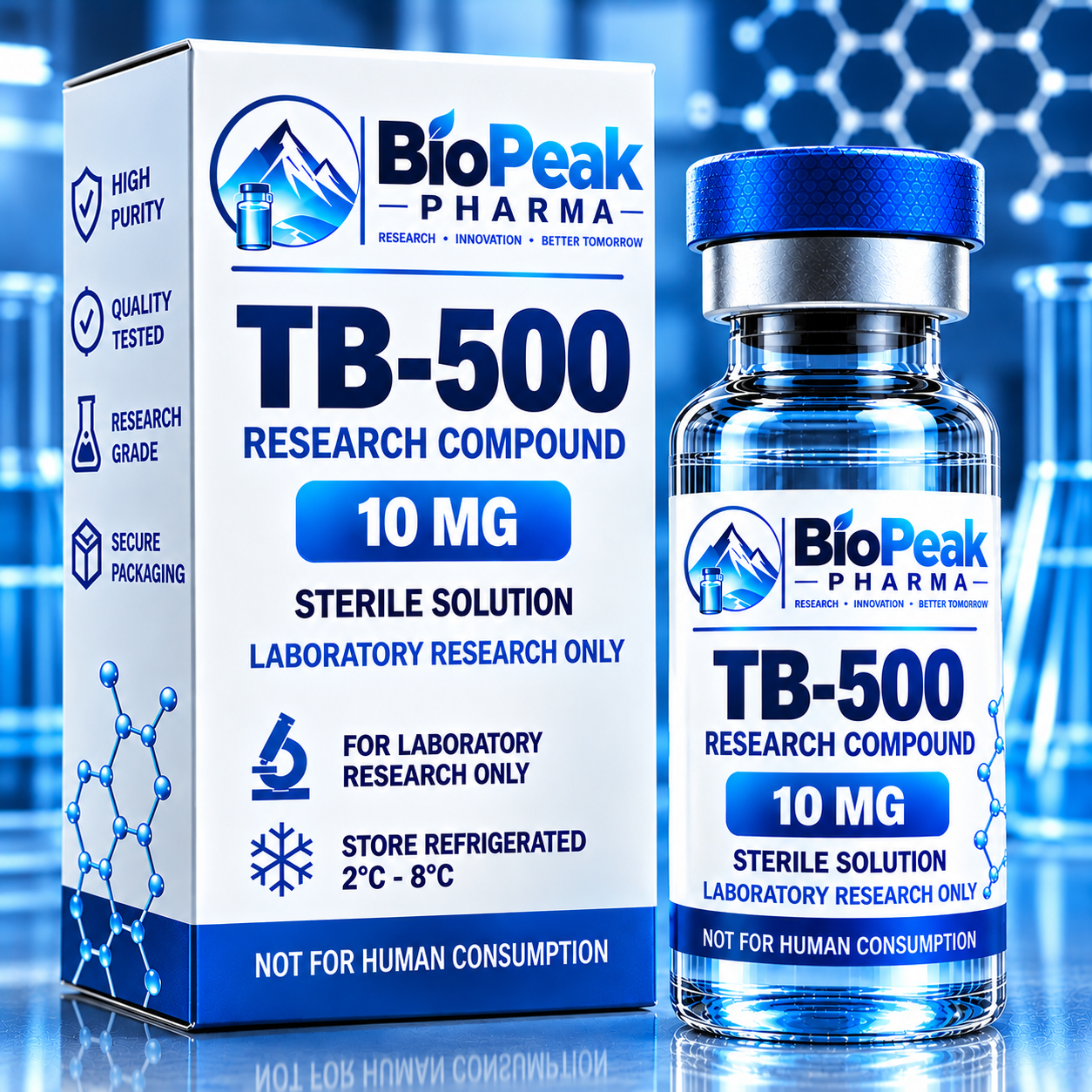
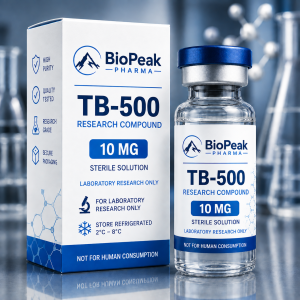
TB-500
$250.00
TB-500
TB-500 is a synthetic peptide fragment associated with thymosin beta-4 (Tβ4) and is widely studied in peptide, cellular, vascular, and tissue biology research. The compound is commonly identified as the N-terminally acetylated seven-amino-acid fragment Ac-LKKTETQ, corresponding to residues 17–23 of thymosin beta-4.
Research interest in TB-500 comes largely from the biological activity associated with the corresponding region of thymosin beta-4. Studies of thymosin beta-4 have examined actin binding, cell migration, angiogenesis, cellular signalling, and tissue biology, providing an important scientific foundation for research into related peptide fragments.
TB-500 is an investigational research compound rather than an established human medicine. Current FDA materials specifically note limited human exposure information and concerns relating to peptide impurities, aggregation, and potential immunogenicity.
What Is TB-500?
TB-500 is commonly used to describe a synthetic fragment of thymosin beta-4.
The compound identified by the FDA as TB-500 is:
N-Acetyl-L-Leu-L-Lys-L-Lys-L-Thr-L-Glu-L-Thr-L-Gln
Often abbreviated as:
Ac-LKKTETQ
This seven-amino-acid sequence corresponds to the 17–23 region of human thymosin beta-4. Analytical research has independently identified the N-terminally acetylated Ac-LKKTETQ fragment in materials described as TB-500.
TB-500 vs Thymosin Beta-4
TB-500 and thymosin beta-4 are related but should not be treated as identical compounds.
Thymosin beta-4 is a naturally occurring 43-amino-acid peptide that has been extensively studied for its role in actin regulation and cellular processes.
TB-500 is generally associated with a shorter synthetic fragment corresponding to the actin-binding region of thymosin beta-4.
This distinction is important when evaluating scientific literature. Research performed with full-length thymosin beta-4 should not automatically be described as evidence for the specific TB-500 fragment.
Research into thymosin beta-4 has identified the LKKTETQ region as part of its central actin-binding domain and has linked this region to cellular migration and angiogenesis-related activity.
TB-500 Research
TB-500 is investigated within several areas of peptide and cellular research.
Research interests include:
- Actin biology
- Cell migration
- Angiogenesis
- Endothelial-cell research
- Tissue biology
- Cellular signalling
- Wound-healing mechanisms
- Extracellular-matrix research
- Peptide chemistry
- Molecular biology
- Musculoskeletal research
- Regenerative-biology models
These areas describe scientific research interests and should not be interpreted as established medical uses.
TB-500 and Actin Research
One of the most important scientific connections involving TB-500 is its relationship to the actin-binding region of thymosin beta-4.
Actin is a major structural protein found inside cells and is essential for processes including cellular shape, movement, division, and organisation of the cytoskeleton.
Thymosin beta-4 binds actin and regulates the balance between actin polymerisation and depolymerisation. Research into the LKKTETQ region has therefore provided a basis for investigating how short peptide sequences related to thymosin beta-4 may influence cellular behaviour.
TB-500 and Cell Migration Research
Cell migration is a fundamental biological process involved in development, tissue remodelling, and numerous cellular responses.
Research into thymosin beta-4 and its active regions has examined mechanisms associated with cell movement and migration. The LKKTETQ sequence has been identified as part of the central actin-binding region associated with these biological effects.
This makes TB-500 relevant to experimental research investigating cytoskeletal organisation and cellular migration.
TB-500 and Angiogenesis Research
Angiogenesis refers to the formation of new blood vessels from existing vascular structures.
Thymosin beta-4 research has investigated angiogenesis and endothelial-cell behaviour in experimental models. Studies of its active peptide regions have also explored mechanisms associated with vascular development and cell migration.
Because vascular biology is relevant to many areas of tissue research, TB-500 and related thymosin peptides continue to attract interest in laboratory studies.
Importantly, preclinical findings should not be presented as proof of an established clinical benefit in humans.
TB-500 and Tissue Biology
Tissue biology is another major area associated with thymosin beta-4 research.
Experimental research has examined thymosin beta-4 in relation to tissue development, remodelling, cellular migration, angiogenesis, and wound-related biological processes.
These findings provide scientific context for why TB-500 is frequently investigated as a research peptide.
However, evidence concerning full-length thymosin beta-4 cannot automatically be transferred to TB-500 because the molecules have different structures.
TB-500 and Musculoskeletal Research
TB-500 and thymosin-related peptides have attracted interest within experimental musculoskeletal research.
Researchers have investigated biological processes involving connective tissue, cellular migration, vascular responses, and tissue remodelling.
A recent review of approved and unapproved peptide therapies found that TB-500 and thymosin beta-4 derivatives have shown interesting findings in preclinical models, while also emphasising that rigorous human safety data remain scarce.
This distinction is essential for responsible scientific communication.
TB-500 Sequence
The TB-500 sequence identified in current FDA documentation is:
Ac-LKKTETQ
The sequence contains seven amino acids with an N-terminal acetyl modification.
The full-length thymosin beta-4 protein is substantially longer, containing 43 amino acids. Consequently, TB-500 should not be described as simply another name for the complete thymosin beta-4 molecule.
TB-500 Product Information
Product: TB-500
Related molecule: Thymosin beta-4
Compound type: Synthetic peptide fragment
Sequence: Ac-LKKTETQ
Length: Seven amino acids
Research areas: Actin biology, cellular migration, angiogenesis, tissue and molecular research
Intended use: Laboratory research only
Human use: Not for human use
Veterinary use: Not for veterinary use
Researchers should consult the current product documentation for exact molecular identity, purity, analytical testing, batch information, storage requirements, and handling instructions.
Quality and Analytical Documentation
Accurate characterisation is particularly important when working with TB-500.
FDA documentation notes that TB-500-related substances may present concerns involving aggregation, peptide-related impurities, and immunogenicity, and that available human exposure information is limited.
Where available, researchers should review:
- Certificate of Analysis (CoA)
- Batch or lot number
- Peptide identity
- Sequence information
- Purity data
- Analytical testing
- Molecular-weight information
- Storage documentation
- Handling information
Batch-specific documentation helps laboratories establish exactly which material was used in an experiment.
TB-500 and Human Evidence
The distinction between preclinical research and human clinical evidence is particularly important for TB-500.
A recent review of peptide therapies reported that TB-500 and related thymosin peptides have demonstrated interesting findings in preclinical research, but rigorous human safety data remain scarce.
FDA materials similarly state that it has not identified human exposure data for drug products containing the thymosin beta-4 fragment and that important safety questions remain unresolved.
For this reason, TB-500 should be presented online as an investigational research peptide, rather than as a proven therapy for injuries, recovery, inflammation, or other medical conditions.
TB-500 and Sports Research
TB-500 has also been the subject of analytical anti-doping research. Scientific testing has identified Ac-LKKTETQ as the peptide associated with TB-500 and developed analytical methods for detecting it in biological samples.
Athletes and sports organisations should always consult the current rules of their relevant governing body before dealing with substances associated with thymosin beta-4 or TB-500.
Frequently Asked Questions
What is TB-500?
TB-500 is a synthetic peptide fragment associated with thymosin beta-4. The compound identified in current FDA documentation is the N-terminally acetylated sequence Ac-LKKTETQ.
What is the TB-500 sequence?
The commonly identified TB-500 sequence is Ac-LKKTETQ, a seven-amino-acid fragment corresponding to residues 17–23 of thymosin beta-4.
Is TB-500 the same as thymosin beta-4?
No. TB-500 is associated with a short fragment of thymosin beta-4, while thymosin beta-4 is a naturally occurring 43-amino-acid peptide.
Why is TB-500 researched?
Research interest includes actin biology, cell migration, angiogenesis, tissue biology, cellular signalling, and peptide chemistry.
What is the relationship between TB-500 and actin?
The TB-500-associated LKKTETQ region corresponds to part of the actin-binding domain of thymosin beta-4, making the sequence relevant to research into actin-related cellular processes.
Does TB-500 have established human clinical benefits?
No established clinical benefit should be claimed. Current reviews describe limited human evidence, while FDA materials identify significant gaps in safety information.
Is TB-500 FDA approved?
TB-500 should not be represented as an FDA-approved medication. FDA materials currently identify substantial gaps in human safety information concerning TB-500-related substances.
Is TB-500 a peptide?
Yes. TB-500 is a synthetic peptide fragment consisting of seven amino acids, with an N-terminal acetyl modification in the form identified by FDA documentation.
Is TB-500 the same as BPC-157?
No. TB-500 and BPC-157 are different investigational peptides with different sequences and biological research backgrounds.
How should TB-500 material be handled?
TB-500 should be handled by appropriately trained laboratory personnel according to product-specific documentation, institutional procedures, and applicable laboratory safety requirements.
Research Disclaimer
This page provides educational information about TB-500 for legitimate laboratory research purposes. It does not constitute medical advice, treatment guidance, or a recommendation for human use.
TB-500 research material is not intended for human consumption, self-administration, or veterinary use. Researchers are responsible for complying with applicable laws, regulations, institutional requirements, laboratory safety procedures, and relevant sporting rules.
TB-500 Research Peptide
TB-500 remains an important subject within peptide and cellular research because of its relationship to the actin-binding region of thymosin beta-4. Research surrounding this peptide and its parent molecule encompasses cell migration, angiogenesis, cytoskeletal biology, tissue biology, and molecular signalling.
For researchers, the most important considerations are accurate molecular identification, reliable analytical documentation, appropriate handling, and careful interpretation of the available evidence. Current regulatory information makes clear that important human safety questions remain unanswered.
Be the first to review “TB-500”
Related products

Recovery & Tissue Research
Recovery & Tissue Research
Recovery & Tissue Research

Recovery & Tissue Research
Reviews
There are no reviews yet.