

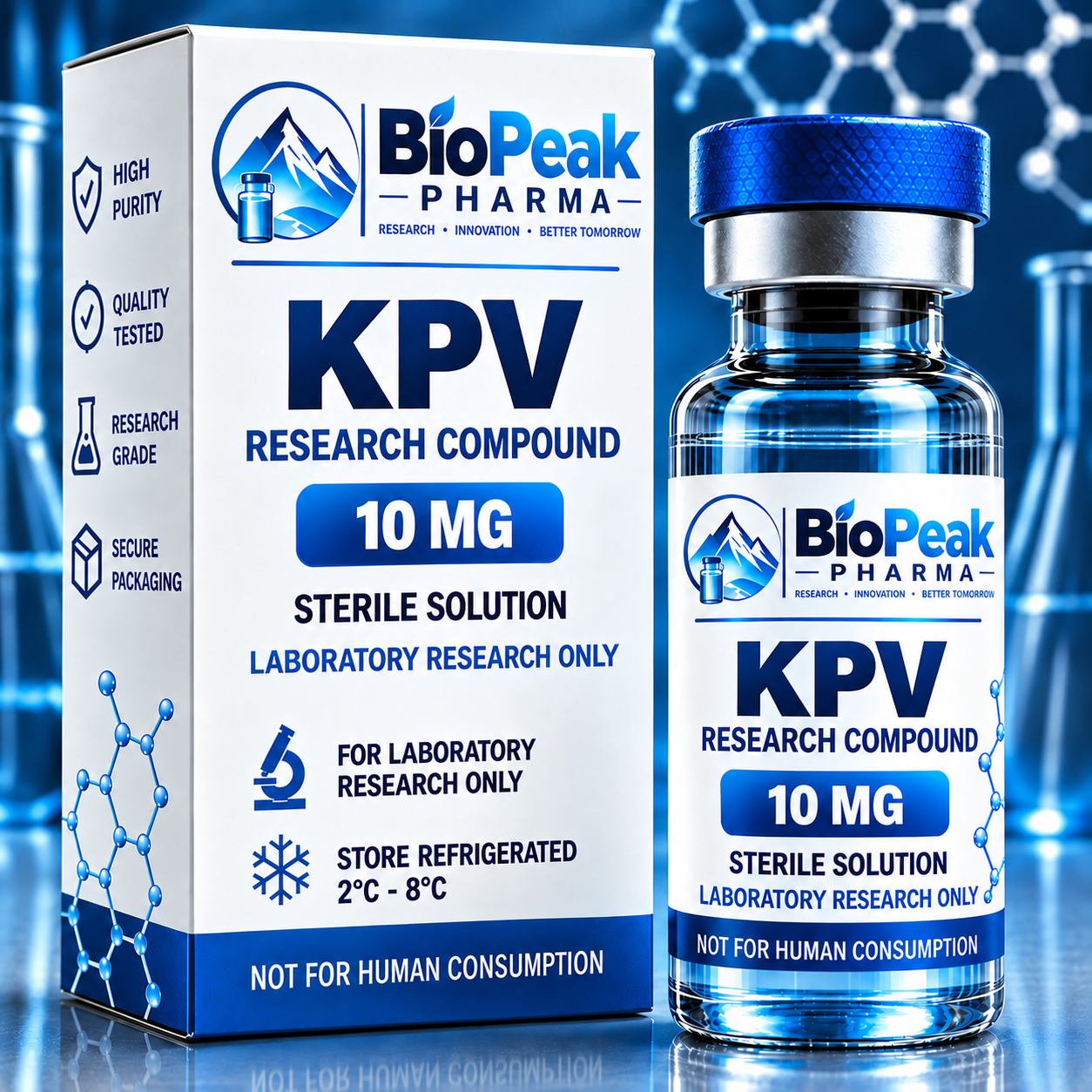
Buy KPV 10mg
$250.00
KPV
KPV is a short tripeptide consisting of the amino acids lysine, proline, and valine. It is derived from the C-terminal region of alpha-melanocyte-stimulating hormone (α-MSH) and has attracted interest in laboratory research involving inflammatory signalling, cellular biology, immune pathways, and tissue-related mechanisms.
KPV is particularly interesting to researchers because α-MSH-derived peptides have been investigated for their interactions with inflammatory and immune signalling pathways. Experimental research has explored KPV in cellular and animal models, providing a basis for further investigation into its molecular activity.
KPV is supplied as an investigational research compound for laboratory use only and should not be represented as an approved medication or marketed for human consumption, self-administration, or veterinary use.
What Is KPV?
KPV is a naturally derived tripeptide sequence associated with the C-terminal portion of α-MSH.
Its three-amino-acid sequence is:
Lys-Pro-Val (KPV)
Although extremely small compared with many commonly researched peptides, KPV has attracted scientific attention because short peptide sequences can retain biologically relevant signalling properties.
Researchers have investigated KPV in experimental models involving inflammatory pathways, cellular responses, epithelial biology, and immune signalling.
KPV Research Overview
Laboratory research involving KPV may investigate:
- Inflammatory signalling
- Immune-cell responses
- Cellular signalling
- Epithelial biology
- Barrier-function research
- Oxidative-stress pathways
- Skin biology
- Gastrointestinal research
- Molecular biology
- Peptide pharmacology
These represent areas of scientific investigation and should not be interpreted as established therapeutic indications.
KPV and α-MSH
KPV is closely related to alpha-melanocyte-stimulating hormone (α-MSH), a peptide involved in several physiological signalling pathways.
The C-terminal sequence of α-MSH contains the KPV motif. Research into α-MSH has investigated its interactions with melanocortin receptors and inflammatory pathways.
KPV is therefore useful as a research model for exploring whether short α-MSH-derived sequences can influence biological signalling independently of the complete parent peptide.
KPV and Inflammation Research
One of the most prominent areas of KPV research involves inflammatory signalling.
Experimental studies have investigated KPV in models involving inflammatory responses and have explored possible relationships between the peptide and pathways regulating inflammatory mediators.
This research has contributed to interest in KPV within molecular biology and inflammation-related research.
However, preclinical observations should not be presented as proof that KPV treats inflammation or inflammatory diseases in humans.
KPV and Cellular Signalling
KPV provides researchers with a small peptide model for investigating peptide-mediated cellular signalling.
Researchers may examine how KPV interacts with cellular pathways and whether its biological effects depend on melanocortin-related signalling or other mechanisms.
Because KPV is only three amino acids long, it is also of interest within research exploring how very short peptide sequences can retain biological activity.
KPV and Skin Research
KPV has been investigated within experimental skin and epithelial models.
Research in this area may examine relationships between KPV, inflammatory signalling, epithelial-cell behaviour, and cellular responses.
These investigations are relevant to broader research into skin biology and cellular barrier function.
KPV should not, however, be described as an established treatment for skin conditions without appropriate clinical evidence.
KPV and Gastrointestinal Research
The gastrointestinal tract contains complex epithelial and immune systems that are highly responsive to inflammatory signalling.
KPV has been investigated in experimental gastrointestinal models as researchers explore the potential biological activity of α-MSH-derived peptides in intestinal and epithelial systems.
This makes KPV relevant to laboratory research involving gastrointestinal biology, epithelial signalling, and inflammatory mechanisms.
KPV peptide and Immune Research
Immune signalling is another area of interest surrounding KPV.
Researchers may investigate how short melanocortin-derived peptides interact with inflammatory and immune pathways and how these interactions influence cellular responses.
Such studies can contribute to a broader understanding of peptide-mediated regulation of immune biology.
KPV Peptide Sequence
The KPV sequence is:
KPV
The three letters represent:
- K — Lysine
- P — Proline
- V — Valine
KPV is therefore classified as a tripeptide.
Its small molecular size distinguishes it from longer research peptides such as BPC-157, TB-500-related sequences, and GHK-Cu.
KPV Product Information
Product: KPV
Full name: Lys-Pro-Val
Sequence: KPV
Compound type: Synthetic tripeptide
Related peptide: α-MSH
Research areas: Inflammatory signalling, immune research, cellular biology, epithelial research
Intended use: Laboratory research only
Human use: Not for human use
Veterinary use: Not for veterinary use
Researchers should consult the current product documentation for information concerning identity, purity, analytical testing, batch details, storage requirements, and handling procedures.
Quality and Documentation
Accurate documentation is important when working with peptide research materials.
Where available, researchers should review:
- Certificate of Analysis (CoA)
- Batch or lot information
- Peptide identity
- Sequence information
- Purity data
- Analytical testing
- Molecular-weight information
- Storage guidance
- Handling documentation
Batch-specific documentation can help laboratories maintain consistency when comparing results across experiments.
Storage and Handling
KPV should be handled by appropriately trained laboratory personnel using suitable laboratory procedures.
Storage requirements can vary according to the specific formulation and packaging. Researchers should follow the current product-specific documentation and applicable laboratory requirements.
Frequently Asked Questions
What is KPV?
KPV is a three-amino-acid peptide consisting of lysine, proline, and valine. It is associated with the C-terminal region of α-MSH and is studied in inflammatory, immune, epithelial, and cellular research.
What does KPV stand for?
KPV represents the three amino acids lysine (K), proline (P), and valine (V).
What is the KPV peptide sequence?
The sequence is KPV, consisting of lysine, proline, and valine.
Is KPV a peptide?
Yes. KPV is a tripeptide, meaning it contains three amino acids.
What is KPV derived from?
KPV corresponds to the C-terminal sequence of alpha-melanocyte-stimulating hormone (α-MSH).
Why is KPV researched?
Researchers investigate KPV in areas including inflammatory signalling, immune responses, epithelial biology, cellular signalling, skin research, and gastrointestinal biology.
Is KPV the same as α-MSH?
No. KPV is a short three-amino-acid sequence associated with the C-terminal portion of α-MSH, while α-MSH is a substantially longer peptide hormone.
Is KPV the same as BPC-157?
No. KPV and BPC-157 are different peptides with different sequences and research backgrounds.
Is KPV intended for human use?
Research-grade KPV should be supplied for legitimate laboratory research and should not be marketed for human consumption or self-administration.
Research Disclaimer
This information is provided for educational and legitimate laboratory research purposes. It does not constitute medical advice, treatment guidance, or a recommendation for human use.
KPV research material is not intended for human consumption, self-administration, or veterinary use. Researchers are responsible for complying with applicable laws, regulations, institutional requirements, and laboratory safety procedures.
KPV Research Peptide
KPV is a distinctive short peptide with an interesting connection to α-MSH and ongoing research into inflammatory signalling, immune biology, epithelial responses, and cellular mechanisms.
Its exceptionally short three-amino-acid sequence makes KPV an interesting model for studying the biological properties of small peptide fragments and their interactions with cellular pathways.
For laboratories researching KPV, accurate peptide identification, appropriate analytical documentation, controlled handling, and careful interpretation of experimental evidence are essential.
Be the first to review “Buy KPV 10mg”
Related products
Recovery & Tissue Research

Recovery & Tissue Research
Recovery & Tissue Research

Recovery & Tissue Research
Reviews
There are no reviews yet.