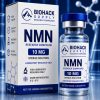

NAD+ 10mg
$110.00
NAD+
NAD+ (nicotinamide adenine dinucleotide) is a naturally occurring coenzyme found in cells throughout the body. It plays a central role in cellular metabolism, redox reactions, energy production, and numerous biochemical signalling processes.
Because NAD+ participates in fundamental cellular pathways, it has become an important subject of research spanning cellular biology, metabolism, mitochondrial function, ageing biology, DNA repair, and molecular science.
NAD+ exists primarily in oxidised and reduced forms, with the oxidised form referred to as NAD+ and the reduced form known as NADH. The NAD+/NADH pair helps cells transfer electrons during metabolic reactions and is closely connected to mitochondrial energy metabolism.
NAD+ research material is supplied for laboratory research purposes only. It should not be represented as an approved treatment or marketed for human consumption or self-administration.
What Is NAD+?
NAD+ is a coenzyme composed of two nucleotide molecules joined through their phosphate groups. It is present in essentially all living cells and participates in a wide variety of enzymatic reactions.
One of its best-known functions is acting as an electron carrier. NAD+ can accept electrons during metabolic reactions and become NADH, while NADH can subsequently donate electrons and return to the NAD+ state.
This reversible process is fundamental to cellular metabolism.
Beyond its role in energy metabolism, NAD+ also serves as a substrate for several enzyme families involved in cellular signalling and maintenance.
NAD+ and Cellular Energy
NAD+ is closely connected to cellular energy production.
During pathways such as glycolysis and the citric acid cycle, NAD+ participates in oxidation-reduction reactions that help transfer energy from nutrients into cellular energy systems.
NADH generated through these reactions can contribute electrons to the mitochondrial electron transport chain, supporting the production of ATP.
For this reason, NAD+ is an important research subject for laboratories studying metabolism and mitochondrial biology.
NAD+ Research Applications
Laboratory research involving NAD+ may investigate:
- Cellular metabolism
- Mitochondrial function
- Redox biology
- Energy metabolism
- DNA repair
- Cellular signalling
- Oxidative stress
- Ageing-related biology
- Sirtuin activity
- PARP-related pathways
- NAD+ biosynthesis
- Metabolic regulation
These represent areas of scientific investigation rather than established therapeutic indications.
NAD+ and Mitochondrial Research
Mitochondria are central to cellular energy metabolism, and NAD+ plays an important role in the biochemical pathways connected to mitochondrial function.
Researchers can investigate NAD+/NADH ratios, electron transfer, oxidative metabolism, and related mitochondrial processes to better understand cellular energy systems.
The relationship between NAD+ availability and mitochondrial biology is therefore an active area of research.
NAD+ and Ageing Research
NAD+ has attracted considerable interest in ageing research because cellular NAD+ levels and NAD+-dependent processes can change with age in experimental models.
Researchers are investigating how NAD+ metabolism interacts with processes such as cellular stress responses, DNA repair, mitochondrial function, and cellular signalling.
NAD+ research should nevertheless be distinguished from claims that NAD+ supplementation or administration has been proven to reverse ageing or extend human lifespan.
NAD+ and DNA Repair Research
NAD+ is used as a substrate by several enzymes involved in cellular responses to DNA damage.
One important enzyme family is poly(ADP-ribose) polymerases (PARPs), which consume NAD+ during specific cellular responses to DNA damage.
Researchers studying NAD+ metabolism can therefore investigate relationships between NAD+ availability, DNA repair pathways, and cellular stress responses.
NAD+ and Sirtuin Research
NAD+ is also required by sirtuins, a family of NAD+-dependent enzymes involved in cellular signalling and regulation.
Sirtuins have been studied in connection with metabolism, mitochondrial biology, stress responses, and ageing-related mechanisms.
The relationship between NAD+ availability and sirtuin activity makes NAD+ an important research compound for laboratories investigating these pathways.
NAD+ Biosynthesis Research
Cells maintain NAD+ through several interconnected biosynthetic pathways.
These include pathways involving precursors such as:
- Nicotinamide
- Nicotinic acid
- Nicotinamide riboside (NR)
- Nicotinamide mononucleotide (NMN)
Researchers studying NAD+ metabolism may examine how these pathways contribute to cellular NAD+ production and turnover.
Understanding NAD+ biosynthesis is important for research into metabolism, cellular signalling, and biochemical regulation.
NAD+ Product Information
Product: NAD+
Full name: Nicotinamide adenine dinucleotide
Oxidised form: NAD+
Reduced form: NADH
Compound type: Cellular coenzyme
Research areas: Metabolism, mitochondrial biology, redox biology, DNA repair and cellular signalling
Intended use: Laboratory research only
Human use: Not for human use
Veterinary use: Not for veterinary use
Researchers should review the current product documentation for information concerning identity, purity, analytical testing, batch details, storage requirements, and handling procedures.
Quality and Documentation
Accurate documentation is important when working with biochemical research materials.
Where available, researchers should review:
- Certificate of Analysis (CoA)
- Batch or lot information
- Compound identity
- Purity information
- Analytical testing
- Molecular information
- Storage guidance
- Handling documentation
Maintaining appropriate batch records can help laboratories improve consistency when conducting repeat experiments.
Storage and Handling
NAD+ should be handled by appropriately trained laboratory personnel using suitable laboratory procedures.
Storage conditions can depend on the specific product formulation and packaging. Researchers should therefore follow the current product-specific documentation rather than relying on generic storage recommendations.
Frequently Asked Questions
What is NAD+?
NAD+ stands for nicotinamide adenine dinucleotide. It is a naturally occurring cellular coenzyme involved in redox reactions, energy metabolism, mitochondrial function, and several signalling pathways.
What does NAD+ do in cells?
NAD+ functions primarily as an electron carrier in metabolic reactions and also serves as a substrate for enzymes involved in cellular signalling, DNA damage responses, and other biological processes.
What is the difference between NAD+ and NADH?
NAD+ is the oxidised form of nicotinamide adenine dinucleotide, while NADH is its reduced form. Cells continuously cycle between these forms during many metabolic reactions.
Why is NAD+ studied in ageing research?
Researchers investigate NAD+ because NAD+ metabolism is connected to cellular energy production, mitochondrial function, DNA repair, sirtuin activity, and other processes relevant to ageing biology.
Is NAD+ a peptide?
No. NAD+ is not a peptide. It is a coenzyme made from two nucleotide components and belongs to a different class of biological molecules.
Is NAD+ intended for human use as a research product?
Research-grade NAD+ should be supplied for legitimate laboratory research and should not be marketed for human consumption or self-administration.
Research Disclaimer
This information is provided for educational and legitimate laboratory research purposes. It does not constitute medical advice, treatment guidance, or a recommendation for human use.
NAD+ research material is not intended for human consumption, self-administration, or veterinary use. Researchers are responsible for complying with applicable laws, regulations, institutional requirements, and laboratory safety procedures.
NAD+ Research Compound
NAD+ is a fundamental cellular coenzyme with broad relevance to biochemical research. Its involvement in energy metabolism, redox reactions, mitochondrial function, DNA repair, sirtuin activity, and cellular signalling makes it an important subject across multiple areas of laboratory science.
For researchers investigating NAD+ biology, clear product identification, appropriate analytical documentation, controlled storage, and responsible laboratory practices are essential.
Be the first to review “NAD+ 10mg”
Related products

Anti-Aging & Longevity
Anti-Aging & Longevity
Anti-Aging & Longevity

Anti-Aging & Longevity
Anti-Aging & Longevity
Anti-Aging & Longevity
Reviews
There are no reviews yet.